BHL and its developers: Chris Sleep

We’re kicking off a brand new series on the blog. In “BHL and its developers”, we meet some of the staff dedicated to setting up the technical components needed for the project. First up: Chris Sleep from the Natural History Museum in London!

Can you tell us something about your work and involvement in BHL-Europe?

My initial involvement with BHL-Europe was with respect to the hardware; the BHL-Europe services are run on an array of machines and storage which is physically hosted here at the NHM in London, where I was involved in the installation and initial configuration. Since then I’ve become more deeply involved with BHL-Europe with the departure of the previous Workpackage 3 leader I’ve up the technical side of the role working closely with Graham Higley the formal WP3 lead, and Lola Obajuluwa who provides our Project Management.

What has been the biggest challenge the developers have faced?

The biggest challenge for BHL-developers so far is the fact that we live in many countries around Europe. Most of the time, every office or institution in the different countries has just one developer – but in our work we all depend on each other. We all need clear sight of what each other are doing and what changes have been done, so that our work builds upon a common base.

So finding a way of raising issues and problems, and discussing and resolving them, was absolutely critical. And we had to do this in a fashion so that wherever we are (be it in a workshop, meeting, conference etc.), we all have access to the information we needed!

So what did you come up with to solve this problem?

The project is one of implementing best practice standards, so the choice for the development environment moved towards a best practice scheme. More specifically, we set up GitHub, which is a code repository where we keep all our source code. This repository is tied to a GitHub issue tracker, where we can raise issues and problems.

Basically, GitHub is a revision source control system. A developer works on the system on his own machine, and “commits” the code if it’s good. This means that changes they’ve made are written up in the GitHub repository, and GitHub keeps track of these changes and what has been done by whom and when.

This is all tied to a component called “Jenkins”, a continuous integration tool that is on the integration server here at the Natural History Museum. You could say that Jenkins “watches” GitHub, and that whenever a change goes through Github, Jenkins grabs it, refreshes the databases and puts the change live so that people can immediately see on the NHM server what the BHL-Europe portal looks like! Similarly, all developers can synchronize GitHub, i.e. pull back changes from GitHub to their machine and know that other developers will do so as well. So even if we’re out of office and working on different machines, we can always work with the other changes that have been done!

Can you give some more info on the GitHub issue tracker?

In short, the issue tracker is a database that’s related to the features we’re building and the bugs associated with them. Issues, such as bugs, are attached to particular milestones. When those issues are closed, they are moved to a test milestone and reopened for testers.


It’s also worth noting that GitHub is an Open Source Free License tool; it’s available to all members of the team and the public. Thanks to GitHub, testers can – if they want to - see the thinking that went on in the implementation. The background info is all there – and it’s not hidden in someone’s email inbox.

When was GitHub implemented?

We started moving the code in GitHub back in June 2011. In August 2011, we linked the code deployment up with Jenkins. We’ve been working with it for the last three to four months.

Before June 2011, we had to build both our integration site and our test site by hand. Developers worked locally on their machines, sent me their codes and then I put everything into place. This caused us a lot of waiting and delay before we could see the developed code. GitHub thankfully is a powerful tool that helps speed up development!

First look: the BHL-Europe portal

The Biodiversity Heritage Library for Europe aims to make early published biodiversity literature accessible to anyone who’s interested. One of the most important access points to this content will be the BHL-Europe portal, which will be available in no less than 12 languages! The portal’s development now nears its end – and it’s high time we take a look at the homepage’s design and functionality.


The BHL-Europe portal

Simple search

The simple search function lets you search for the most frequent metadata: title, author, year (date of publication) and scientific name. Obviously, you need to enter at least one of those to perform a search. Several web services are integrated in the simple search: these include autocomplete search, fuzzy search and taxon finder for a scientific query.

In addition to this simple search, an advanced search option will also be available. More info on this function in the next development update!

Content highlights

One of the coolest features of the homepage is the rotating carousel. This carousel demonstrates some content highlights which are randomly generated from the content highlight archive whenever you visit the page.

Clicking on one of the books in the carousel will lead you to its bibliographic page (see next update). From there, you can simply read the book or download it in various formats. A pretty nifty way to uncover some hidden treasures in the BHL, don’t you think?

Help and tutorial

The rotating hint bar shows the user some useful information on the portal and gives him hints on how to effectively use its functionalities. A link to the BHL-Europe tutorial is also prominently displayed.

Social media bar

Finally, there’s the social media bar, which displays the last 3 posts on the BHL-E blog, Twitter and Facebook. This way, visitors directly see what we’ve been up to – and can easily click through to subscribe, like or follow. You can also subscribe to the BHL-Europe RSS-feed to keep up to date.
That’s it for our first look at the portal. Our next update will feature much more info (including on the advanced search option), there’s an interview with one of our developers coming up… stay tuned!

Authors: Jiří Frank and Nicolas Van Audenhove

BHL-Europe featured on regional Czech radio

On 6 January 2012, the BHL-Europe project was mentioned in the talk show “Our Guest”, on the regional Czech radio station Český Rozhlas Plzeň. This station covers one quarter of the Czech Republic and is also broadcast online.

The project was mentioned by Jiří Frank senior, the father of BHL-staffer Jiří Frank. Even though he is retired now, Frank sr. is a consultant for the Biodiversity Library Exhibition - a virtual exhibition of the content found in the Biodiversity Heritage Library for Europe. Frank always did have a thing for literature – since his retirement, the former sailor and professional chef cook has become a succesful writer with two published story books!

The goal of the programme was to talk about stories on mariners, spices and modern pirates – but we’re very grateful that he was willing to mention our project on the radio. Thanks!


The two Jiří's with their dogs Šerina (L) and Sára (R) 

Authors: Jiří Frank and Nicolas Van Audenhove

Farmers Market welcomes BHL-Europe

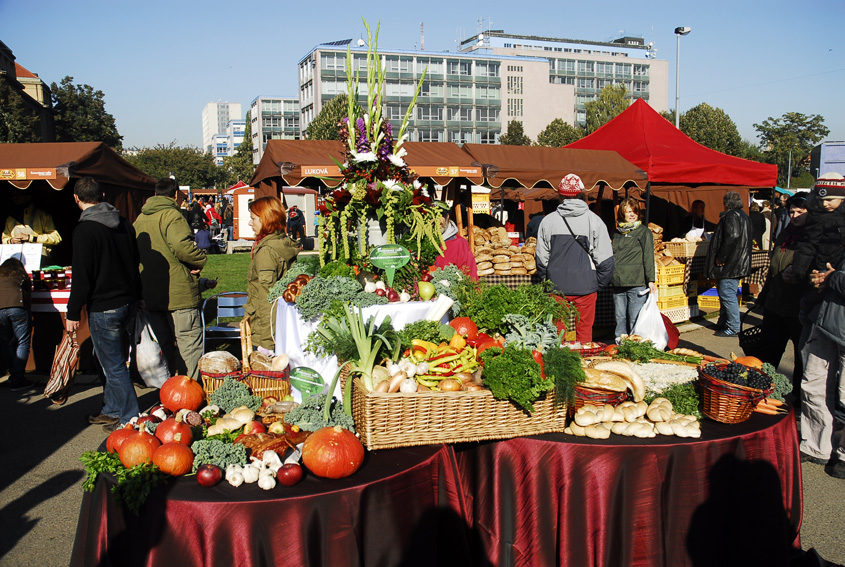
The Farmers market in Prague (Czech Republic) was held several days before Christmas. Given that the farmers market attracts thousands of people (especially before holiday seasons), we jumped on the opportunity to present the BHL-Europe project!


But what does BHL-Europe have to do with a farmers market? The answer lies in the Biodiversity Library Exhibition – a virtual exhibition of the content found in the Biodiversity Heritage Library for Europe. The first such exhibition focuses on spices, and their representation in old biodiversity literature. That’s why we decided to organize a “Get to know the spice”-event. Children and families were treated to a degustation, as well as to a variety of games and puzzles.
The BHL-Europe virtual exhibition BLE will officially be launched in February, but visitors to the Farmers market already got a good taste of what’s coming!

Check out more photos of the event on our Facebook page!

Author: Jiri Frank (National Museum, Prague)


BHL-Europe Newsletter and Website News

You want to stay up to date on the Biodiversity Heritage Library for Europe? Then don’t forget to subscribe to the BHL-Europe newsletter! It will keep you posted on the project’s development status, meetings between consortium members, other digitization projects and much more…

The last newsletter dates from November 2011. It contains a variety of news worth checking out. Previous newsletters are found in the archive.

In other news, the BHL-Europe’s official website is now also available in Polish and Finnish, bringing the total of languages that the site is available in to ten. Soon to come: Portuguese, Hungarian and Dutch! Just like the BHL-Europe portal, the official website will eventually be available in 14 languages. Take a look!